


|
Speedometer Adjustment & Gear Development Calculator |
|
|
| Talla bicicleta Guía completa Gravel Niños Eléctrica Cuentakilómetros |
How to calibrate your bike speedometer?
There are several ways to obtain your bicycle wheel perimeter and correctly calibrate your speedometer.
- The simplest method is to check the instruction manual for the wheel perimeter value. This value is based on wheel diameter, but often the measurement is too generic. For example, 26 inches without specifying tire width — the diameter variation can be significant, leading to incorrect distances and speeds.
- The second method uses the tool on this page. Simply select your tire size and you'll get the wheel perimeter in millimetres, ready to enter into your speedometer. This calculation is based on the international ISO 5775 standard (ETRTO).
- You can also measure experimentally: mark the ground, rotate the wheel one full turn, and measure the distance traveled. Use the tire valve as a reference point to know when a full rotation is complete.
Inaccuracies of all three methods
None of these methods will give you a 100% exact measurement, because the tire deforms at the contact point with the ground — something none of the methods account for. Deformation varies with your weight, tire pressure, and terrain. However, the error is minimal. To further reduce it, you can slightly decrease the values obtained with any of the three methods.
Gear Development Calculation
We can observe that increasing the chainring size (number of teeth) or decreasing the cassette cog size makes you travel further per pedal stroke, but also requires more leg force. Each pedal stroke is converted — via chainring, chain, and cassette — into X wheel rotations. To calculate distance per pedal stroke: divide the chainring teeth by the cassette teeth to get wheel rotations per pedal stroke. Multiply that by the wheel perimeter and you'll get the distance traveled per pedal stroke.
ISO 5775 Wheel Perimeter Calculation
Bicycle tire sizes follow different naming conventions: millimetres for road bikes (700Cx21) and inches for mountain bikes (26x2.00). The ISO 5775 standard unifies these by specifying two values in millimetres: tire profile height and rim diameter. Example: 26x2.00" (ISO 50-559). The rim diameter is 559 mm and the profile height is 50 mm, so the total wheel diameter is 559 + (2×50) = 659 mm. To calculate the perimeter: Π × diameter = 3.1415 × 659 = 2070.24 mm — the value to enter into your speedometer.: en milímetros para bicicletas de carretera (700Cx21) y en pulgadas para bicicletas de montaña (26x2.00).
Para unificar estos sistemas existe una norma ISO (International Organization for Standardization) que clarifica las dimensiones de la rueda.
La normativa ISO especifica 2 valores siempre en milímetros: altura del perfil de la cubierta y diámetro de la llanta.
Viéndolo con un ejemplo: 26x2.00" (ISO 50-559)
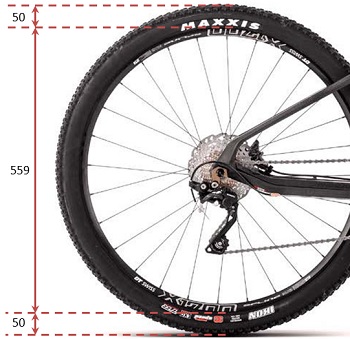
Bicycle tire sizes follow different naming conventions: millimetres for road bikes (700Cx21) and inches for mountain bikes (26x2.00). The ISO 5775 standard unifies these by specifying two values in millimetres: tire profile height and rim diameter. Example: 26x2.00" (ISO 50-559). The rim diameter is 559 mm and the profile height is 50 mm, so the total wheel diameter is 559 + (2×50) = 659 mm. To calculate the perimeter: Π × diameter = 3.1415 × 659 = 2070.24 mm — the value to enter into your speedometer.
La altura del perfil hay que sumarla dos veces como se ve en el gráfico.
Para calcular el perímetro, que es lo que interesa a la hora de configurar el cuentakilómetros de la bicicleta, aplicamos Π x diámetro.
Siendo por lo tanto en este caso el perímetro 3,1415 x 659 = 2070,24 milímetros, que será el valor que deberemos introducir en el cuentakilómetros.
MTB Tire Width
In mountain biking, tire measurements often vary between brands — a 2.00-inch tire from one brand may be wider than a 2.1-inch tire from another. To compare tires across brands, use the ETRTO (ISO) number: the first value indicates profile height. Comparing ETRTO values between tires will show you which one has a larger or smaller width.
In mountain biking, tire measurements often vary between brands — a 2.00-inch tire from one brand may be wider than a 2.1-inch tire from another. To compare tires across brands, use the ETRTO (ISO) number: the first value indicates profile height. Comparing ETRTO values between tires will show you which one has a larger or smaller width. (ISO). Recordamos que el primer valor indica la altura del perfil. Comparando los valores ETRTO de diferentes neumáticos veremos cuál tiene mayor o menor balón (anchura).
Related articles
Enter your measurements and get your exact bike size for MTB, road and urban.
Charts, formulas and tips for MTB, road and urban bike sizing.
Stack, reach and gravel geometry explained by model.